

We hear this question at the counter all the time, usually from someone who already owns a Glock 17 and doesn't want to buy a second gun just to carry. Here's the straight answer, then the setup that makes it work.
Can You Conceal Carry a Glock 17? The Short Answer
Yes. Plenty of people carry a Glock 17 concealed every day. It's a full-size pistol, so it asks more of your gear than a compact or subcompact does, but it isn't a range gun that can only live in a nightstand.
Whether it works for you comes down to five things:
- Holster: rigid, covers the trigger guard, and pulls the grip into your body
- Belt: stiff enough to hold the weight without sagging
- Carry position: where on your waistband the gun rides
- Clothing: what you wear over it
- Body type: your height, torso length and build
When those line up, a Glock 17 hides better than most people expect. When one is off, it prints, pokes and sags, and the gun gets blamed.
The Glock 17 is a solid EDC (everyday carry) choice if you: already shoot it well, have medium to large hands, are average height or taller, or want one gun for home defense and carry.
You may be happier with a smaller Glock if you: have a small frame or short torso, wear fitted clothing most of the year, or need deep concealment under a strict dress code.
For law enforcement readers: if you carry a Glock 17 on duty, carrying the same grip, trigger and magazines off duty is a legitimate reason to stick with the 17 instead of switching platforms.
Glock 17 Size and Weight: What You're Actually Hiding
The Glock 17 is Glock's standard full-size 9mm. Next to the compact and subcompact models it has a longer slide and barrel, a taller grip and a bit more weight. Exact figures shift slightly between generations, so check Glock's spec sheet for your pistol.
What matters more than the numbers is where that size sits on your body.
The grip is the problem, not the barrel. Carried inside the waistband, the slide and barrel ride below your belt line, between your pants and your body. Extra slide length there is mostly hidden. The grip sits above the belt, and that's the part pushing against your shirt.
Loaded weight adds up. A full magazine adds real weight on top of the pistol. Over a full day, that's what makes a cheap belt sag and a soft holster tip away from your body.
Capacity is a big part of the appeal. The standard Glock 17 magazine holds 17 rounds. A capacity comparison of the G17 and G19 sums up the trade: two extra rounds (17 vs. 15) and a longer grip that suits shooters with large hands. Many carriers decide that's worth a little more effort on concealment.
Is the Glock 17 Too Big for CCW?
It's bigger than a compact or subcompact. But for most adult carriers with the right setup, it isn't too big for CCW (carrying a concealed weapon).
One term you'll see a lot: printing means the outline of the gun showing through your clothes. With a Glock 17, the usual culprit is the back corner of the grip pushing out against your shirt when you bend or reach.
A G17 is not the right conceal carry gun for most people, men or women. I've done it, but had to make compromises everywhere to make it work.Read on Reddit ↗
What a full-size gun gives you
- Longer sight radius: more distance between front and rear sights, which many shooters find easier for precise shots
- Full grip: all your fingers on the gun, which usually means better recoil control and faster follow-up shots
- Capacity: more rounds before a reload
- Shared magazines: if your home or duty gun is a 17, your carry mags are interchangeable
- One manual of arms: you train on the same gun you carry
What it costs you
- Weight: you'll feel it by evening without a proper belt
- Sitting and driving: the longer slide can dig into your thigh or hip in some positions
- Summer: thin, tight shirts make the grip harder to hide
Body type matters
Taller carriers and people with longer torsos usually hide a Glock 17 more easily, because there's more room between belt and ribs for the gun to sit flat. Larger-framed carriers have more body to wrap a holster around. Smaller-framed carriers can still do it, but the grip is more likely to print, and appendix carry or a compact Glock may suit them better.
Glock 17 vs Glock 19 for Concealed Carry
This is the comparison almost everyone makes, so here's the quick version.
| Feature | Glock 17 | Glock 19 |
|---|---|---|
| Size class | Full-size | Compact |
| Standard capacity (9mm) | 17 rounds | 15 rounds |
| Grip | Taller, full grip for most hands | Shorter, pinky may hang for large hands |
| Slide/barrel | Longer | Shorter |
| Concealment | Harder, mainly due to grip | Easier |
The Glock 19's shorter grip is the real reason it conceals easier.
Slide length matters much less inside the waistband, since the 17's extra slide rides below the belt anyway.
The 17 often makes more sense when you:
- Carry appendix, where some carriers find the longer slide helps the gun sit flatter against the body
- Are tall or long-waisted
- Want the same gun at home, at the range and on your belt
- Carry a 17 on duty and want identical controls off duty
For the full side-by-side, read our Glock 17 vs 19 concealed carry comparison.
How to Concealed Carry a Glock 17: The Setup That Makes It Work
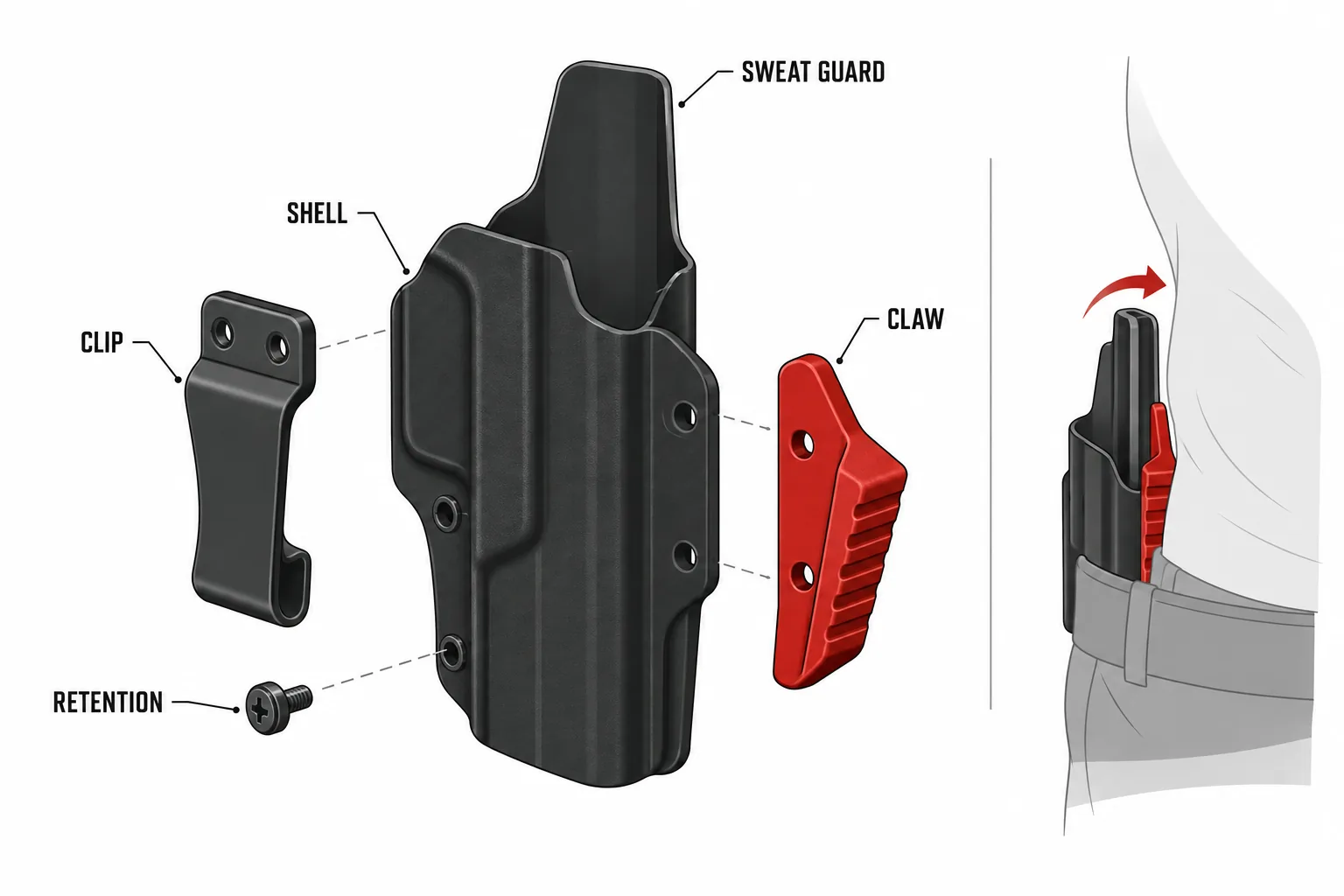
Carrying a full-size gun is a system: holster, belt, position, clothing and body all have to cooperate. Change one and the others shift.
The most common beginner mistake is blaming the gun when the gear is the problem. A Glock 17 in a floppy holster on a department-store belt will print and sag. The same gun in a rigid holster on a real gun belt can disappear under a regular t-shirt for many carriers.
Pick the Right Holster
IWB vs OWB. IWB (inside the waistband) holsters sit between your pants and your body, so your waistband and shirt cover most of the gun. OWB (outside the waistband) holsters ride on the outside of your belt. OWB is comfortable and fast, but with a full-size pistol it needs a jacket or a long, loose overshirt to stay hidden. For hiding a 17 under everyday clothes, IWB is the starting point.
Why Kydex. Kydex is a rigid thermoplastic heat-molded to the exact shape of the gun. It holds that shape, so your draw feels the same every time, and the holster mouth stays open after the draw so you can reholster one-handed without it collapsing.
Must-have features:
- Full trigger guard coverage. Nothing should be able to reach the trigger while the gun is holstered.
- Adjustable retention. Retention is how firmly the holster grips the gun. Tight enough that the gun stays put when you bend, run or sit, not so tight it fights your draw.
- Adjustable cant. Cant is the forward or rearward tilt of the holster. A little cant can tuck the grip closer to your body and make the draw more natural.
- A claw or wing. A small piece on the holster that presses against your belt and rotates the grip in toward your body. On a full-size gun, it's one of the biggest single fixes for grip printing.
Lights and optics. If your 17 wears a red dot or weapon light, the holster has to be cut for it. Don't force an optic-equipped gun into a holster that wasn't made for it.
Safety rule: never carry in a pocket or stuffed in your waistband without a holster. A holster that covers the trigger is the most important safety gear you'll carry. We go deeper in what to look for in the best holster for the Glock 17.
Choose a Carry Position: Appendix vs Strong-Side IWB vs OWB
Positions are usually described like a clock face, with 12 o'clock at your belly button.
Appendix IWB (AIWB), about 12 to 1 o'clock. The gun rides in front, just off center. Many Glock 17 carriers find this is where the full-size gun hides best: the slide runs down along the front of the hip, and with a claw the grip tucks into your stomach. Bending over pushes the grip into your body instead of out. A longer slide can pinch when sitting for some builds, so test it.
Strong-side IWB, about 3 to 4 o'clock (for right-handed carriers). The gun sits on or just behind the hip. Some people find this more comfortable, especially for driving. The trade-off: when you bend or reach, your shirt pulls tight across your back and the grip is more likely to print.
OWB. The most comfortable option and often the fastest draw. With a full-size Glock, it's realistic concealment mainly under a jacket, vest or untucked overshirt, so it's popular in cooler months.
Your torso decides a lot. Short-waisted carriers sometimes find a 17 jabs the ribs at 3 o'clock but sits fine at appendix. Carriers with a larger midsection often prefer strong-side or slightly behind the hip. There's no single right answer, only what works on your body.
Appendix safety: holster slowly and with full attention, keep your finger off the trigger, and make sure shirt fabric, drawstrings and zippers are clear of the holster mouth before the gun goes back in. Look the gun into the holster if you need to. There's never a reason to reholster fast.
Use a Real Gun Belt
A Glock 17 needs a stiff, reinforced gun belt. A dress belt or regular leather belt bends under the weight, the holster tips away from your body, and the grip starts sticking out. It also gets uncomfortable fast, because the weight hangs on one spot.
A proper gun belt spreads the load across your waist and holds the holster tight against you. Wear it snug, not cinched, and you may need to go a notch tighter when you're carrying. Then wear the whole setup around the house for a few hours before you judge it.
Dress Around the Gun
You don't need a new wardrobe, but some choices make a full-size gun much easier to hide.
Clothing that helps:
- Darker colors and patterns, which break up shadows and outlines
- Untucked shirts long enough to cover the grip when you raise your arms
- Flannels or button-ups worn open over a t-shirt, and hoodies
- Jackets and vests in cooler weather
Clothing that works against you:
- Tight or thin t-shirts, especially light colors
- Short shirts that ride up when you reach
- Pants with no extra room at the waist
For IWB carry, many people go up about one waist size in pants, or wear pants with a little stretch, to make room for the holster.
Do the mirror test. Bend over like you're tying your shoes, reach for a high shelf, sit down, and turn side to side. Check from the side and the back. That tells you more than any spec sheet.
Comfort Tips for Carrying a Full-Size Glock All Day
- Adjust before you give up. Ride height (how high or low the gun sits) and cant make a big difference. A lot of carriers who say a 17 doesn't work never adjusted their holster out of the box.
- Give it a break-in period. A new setup usually feels strange for the first several days. You'll get used to it and find the small tweaks.
- Sitting and driving. If the muzzle digs into your thigh at appendix, try a small change in ride height or cant. Some carriers shift slightly off center for long drives.
- Change the cover, not the gun. Same Glock 17 year-round: OWB under a coat or open flannels in winter, appendix under looser shirts in summer.
- Practice drawing from concealment. With an unloaded gun, in a safe area with no ammunition in the room, practice clearing your cover garment and drawing smoothly. Then train live at the range. Hiding the gun is only half the job.
Does the Glock 17 Jam Easily?
Not in normal use. The Glock 17 has a long service record: according to Glock's company history, the Austrian Army accepted the Glock pistol as its service pistol in 1982, and in 1984 the Glock 17 passed the NATO durability test. It's broadly regarded as a reliable pistol.
When a Glock 17 does malfunction, the cause is usually one of these:
- Ammunition: cheap, reloaded or out-of-spec ammo
- Magazines: worn springs, damaged feed lips, or aftermarket mags that don't run well
- Neglect: a dirty or bone-dry gun
- Limp-wristing: a weak grip that doesn't give the slide enough to work against
Carry gun upkeep: clean and lube regularly, inspect your magazines, and carry defensive ammo you've actually fired through your own gun. Carry guns pick up lint and debris from clothing, so check inside your IWB holster now and then and clean it out.
What Glocks Can You Conceal Carry?
Practically any Glock can be concealed with the right gear. Smaller models just make it easier. By size class:
- Full-size: Glock 17 (9mm), Glock 22 (.40 S&W). Most capacity, longest grip.
- Compact: Glock 19 (9mm), Glock 23 (.40). The classic do-everything carry size.
- Subcompact: Glock 26 (9mm), Glock 27 (.40). Short grip, easy to hide, less capacity.
- Slimline: Glock 43X, Glock 48. Thinner frames built for concealment.
- .45 ACP: the Glock 30 packs .45 into a short grip.
Pick the gun that fits your body, wardrobe and shooting ability, not just the size label. A subcompact you can't shoot well is no upgrade over a 17 you shoot confidently.
Whatever you choose, the holster still matters. Kydex holsters are made for most of these models, whether you need a Glock 23 holster, a Glock 27 holster, a Glock 30 holster or a Glock 43X OWB holster.
Know Your Local Carry Laws
US carry laws are set state by state, and cities and counties can add rules about where you may carry. As this overview of permitless carry state laws explains, each state sets its own requirements and limits; a number of states allow permitless concealed carry, while others require a permit. Reciprocity (whether another state honors your permit) varies too, and these rules change over time.
Before you carry, and especially before you travel, check current law for every state you'll be in and know where carry is prohibited. If you're unsure whether your holster choice has legal implications, see Is It Illegal to Conceal Carry Without a Good Holster?
Where an Incognito Concealment Holster Fits In
If you've decided to carry a Glock 17, the holster makes or breaks the setup. It keeps the trigger covered, holds the gun steady, and pulls that long grip into your body.
That's what we build. Our Kydex holsters are made by hand in Sterling Heights, Michigan, in the same building as our partner gun shop, IFA Tactical, and every one is covered by a Limited Lifetime Warranty.
For the Glock 17, that includes:
- IWB holsters for strong-side concealed carry
- Appendix (AIWB) rigs for carrying the 17 up front
- OWB holsters for jacket weather and comfort
- Trigger guard holsters for minimal, low-profile carry
- Light and red-dot cuts if your 17 runs an optic or weapon light
- Left-handed versions
- Level 2 duty holsters for law enforcement
If you're ready to start, our Quick Ship IWB holster for the Glock 17 is a straightforward place to begin. Running an unusual light, optic or other attachment? Use our Gun Model Request page and we'll look at building one for your setup.
Want to compare carry positions and accessory cuts side by side? Browse our full lineup of Glock 17 holsters and pick the one that matches how you actually carry.


