Concealed Carry Holsters for Women: Types and How to Choose
May 7th 2021
Quick Answer: What Is the Best Concealed Carry Holster for a Woman?
For most women, the best place to start is a quality Kydex IWB or appendix holster worn on a sturdy gun belt. Kydex is a rigid plastic that gets heat-molded around a specific gun. IWB stands for inside the waistband: the holster rides between your body and your pants, and your top covers the grip. AIWB, or appendix inside the waistband, is the same idea at the front of your body, around the 12 to 1 o'clock position.
Belt-mounted holsters give you the best overall mix of concealment, draw speed, retention, and gun compatibility. Most carry classes and training material are built around them too, so instruction is easier to find.
Specialty gun holsters for women, such as belly bands, corsets, bra holsters, and thigh holsters, solve real wardrobe problems. They also come with trade-offs we'll walk through below.
The honest answer: the best female concealed carry holster is the one that fits your gun, your body, and your clothes, and that you'll actually wear every day.
Why Women's Holster Needs Can Differ
Women carry for the same reasons men do: to protect themselves and the people they care about. And a lot of new carriers are women. The 2021 National Firearms Survey analysis of pandemic-era gun purchasing estimated that roughly half of all new gun owners in 2019 through 2021 were female.
The core rules for a safe holster don't change with gender. What changes is fit and wardrobe:
- Build. Many women have a more pronounced hip-to-waist ratio, a shorter torso, or a higher natural waistline. A grip that sits flat on one body can dig in or stick out on another.
- Clothing. Dresses, skirts, leggings, fitted tops, and belt-free pants all change where a holster can ride.
- Advice gap. A lot of holster advice is written by and for men, so positions and settings often need adjusting.
None of this rules out any carry method. It just means you should expect some trial and error before you find what works.
What Every Gun Holster for Women Must Do
A ladies gun holster gets held to the same standards as any other holster. If it fails any of these, it's not a good carry holster, no matter how it's marketed.
Cover the Trigger Guard
Full trigger guard coverage is non-negotiable. While the gun is holstered, nothing (a finger, a shirt hem, a purse strap) should be able to reach the trigger. A rigid holster also keeps its mouth open after the draw, so you can reholster one-handed without material folding into the gun.
Minimal trigger guard holsters, which cover only the trigger guard area, exist for specific uses such as pocket or bag carry. Same rule applies: the trigger must be fully enclosed.
Retention and Security
Retention is how firmly the holster holds your gun until you deliberately draw it. There are two basic kinds:
- Passive retention relies on friction and a precise molded fit. The gun clicks in and stays put until you pull it out with intent.
- Active retention adds a mechanism you have to defeat, such as a thumb break strap or a release button.
A good Kydex holster usually lets you tune retention with adjustment screws: tight enough to stay put during a jog to the car, not so tight it fights your draw. Law enforcement readers carrying openly on duty may want a Level 2 duty holster, which adds an active retention device on top of the molded fit.
Accessibility
You carry a gun to use it in an emergency, so you have to be able to reach and draw it under stress. Accessibility depends on carry position and clothing as much as on the holster. If you carry under a skirt or dress, you need a reliable way to sweep or lift the fabric clear. Practice that motion with an unloaded gun until it's automatic.
Concealability and Comfort
A holster that hurts gets left in the drawer. Comfort and concealment go hand in hand, and a few terms come up a lot:
- Printing is when the outline of the gun shows through your clothes.
- Cant is the forward or rearward tilt of the holster. A little forward cant at the hip can tuck the grip into the curve of your back.
- Ride height is how high or low the gun sits relative to your belt.
Adjustable cant and ride height let you fit a holster to your curves. Concealment claws and wings press against your belt and rotate the grip toward your body, which cuts down on printing.
Kydex vs. Leather: Which Holster Material Is Better?
Leather is the classic holster material, and it looks good. Over time, though, it softens. A worn leather holster can collapse when the gun is out, which makes reholstering harder and less safe.
A Kydex holster holds its shape, handles sweat and moisture, and keeps the mouth open. Because it's molded around a specific gun, it can be cut precisely for that model, including weapon lights and red dot optics. Hybrid designs that pair a Kydex shell with a leather or fabric backer also exist. For daily carry, especially on a smaller frame where every bit of bulk counts, we think a well-built Kydex holster is the better tool.
Concealed Carry Positions Explained (The Clock Method)
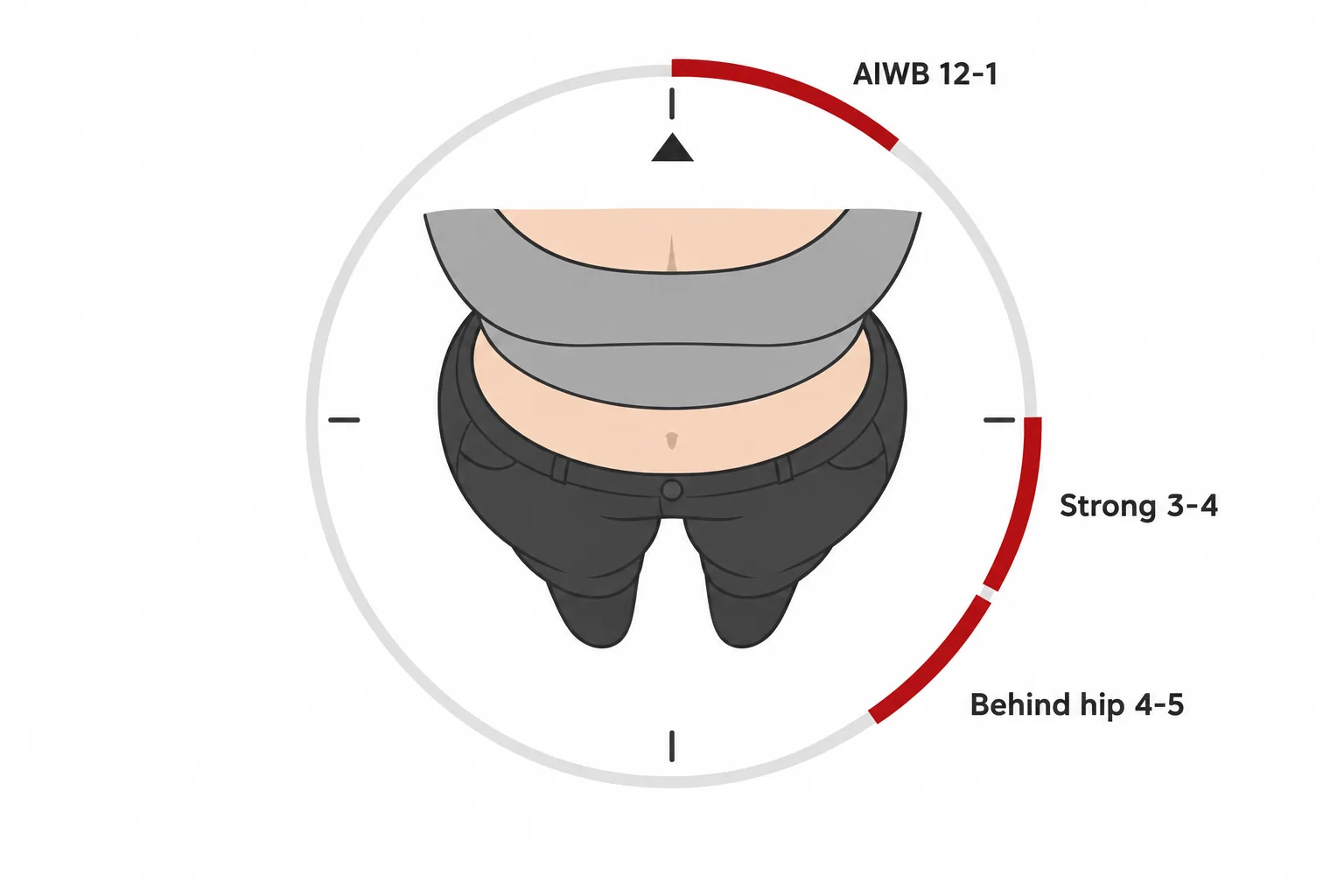
Carry positions are described like a clock face. Picture yourself standing in the middle: 12 o'clock is your belly button, 3 o'clock is your right hip, 6 o'clock is the small of your back, and 9 o'clock is your left hip. Left-handed shooters mirror everything and should look for left-handed holster versions.
- Strong side (3 to 4 o'clock): Your dominant-hand side, at or just behind the hip. A natural, familiar draw.
- Behind the hip (4 to 5 o'clock): Often more comfortable for women with wider hips or fitted pants, because the gun rides in the curve of the lower back instead of on the hip bone.
- Appendix (12 to 1 o'clock): Directly in front, for fast access.
- Cross-draw: Carried butt forward on the support side, opposite your dominant hand.
- Small of back (6 o'clock): We discourage it. Falling backward onto a gun against your spine can hurt you, and the draw is awkward.
So what's the best concealed carry position for women? For many, appendix or behind the hip. A shorter torso or high natural waistline can make appendix harder; wider hips can make strong-side hip carry dig in. Try both before deciding.
Women's Concealed Carry Holster Types: Pros and Cons
Here's an honest look at each option for female bodies and wardrobes.
Inside-the-Waistband (IWB) Holsters
An IWB holster rides between your body and your pants on a gun belt. Your waistband covers most of the holster and your top covers the grip, so often the only visible part is the belt clip. Browse Kydex IWB holsters molded for your exact gun to see the fits available.
Pros:
- High concealment for the size of gun carried
- Strong retention when clipped to a belt
- Adjustable ride height and cant to match your shape
Cons:
- Needs a sturdy belt and a long enough cover garment
- You may need pants one size up
- Larger guns can dig in at the hip
You don't need a baggy jacket. A loose top, or even a T-shirt or tank top that's long enough, can hide an IWB gun. Busy patterns help break up any outline. Some clips grab the waistband of belt-free pants, but a belt is more secure and holds the gun steadier.
Appendix (AIWB) Holsters
Appendix holsters are IWB holsters built specifically for the 12 to 1 o'clock position. Use a dedicated appendix design, not a hip IWB holster moved to the front. A 2-piece appendix rig pairs the holster with a magazine carrier in one unit.
Pros:
- Fastest access, since the grip sits right in front of you
- Uses the front of your body to hide even larger pistols
- Works with light summer clothes
Cons:
- Requires a dedicated AIWB holster
- The muzzle points toward your thigh and groin, so a negligent discharge (an unintended shot caused by handling error) has serious consequences
- A short torso, high waistline, or pregnancy can make it uncomfortable
If the grip tips forward and prints, a concealment claw pushes it back toward your body.
Outside-the-Waistband (OWB) Holsters
An OWB holster rides on the outside of your pants on a gun belt, like a traditional police holster.
Pros:
- The most comfortable belt holster, since nothing presses into your body
- Easiest draw
- Handles mid-size and full-size pistols well
Cons:
- Needs a cover garment, like a jacket or a long untucked top
- Harder to conceal in hot weather or under a strict dress code
- Watch for exposure when you reach overhead or bend
Pear and hourglass shapes have an edge here: the curve of your hips helps hide a behind-the-hip OWB holster. Popular carry guns such as the Glock 43X have OWB holsters molded specifically for them.
Belly Band and Corset Holsters
These wrap around your waist or ribcage and close with hook-and-loop, zippers, or clasps. Corset styles often include a magazine pocket.
Pros:
- No belt needed
- Works with dresses, athleisure, and outfits where waistband carry isn't practical
Cons:
- Less retention than a belt-mounted Kydex holster
- Can shift as you move
- Slower draw
Only use designs with a rigid trigger guard covering, not a soft fabric pocket.
Bra Holsters
If you're searching for the best female concealed carry holster bra, here's the straight answer: bra holsters hang a small gun from or near the bra line for deep concealment under dresses and fitted tops, and they only work with subcompact and micro pistols. Whether one works for you depends on your cup size, body type, and gun. Drawing usually means lifting your top, so it's slower. Insist on full trigger guard coverage and practice the draw.
Thigh Holsters
This isn't the drop-leg rig you see on tactical teams. A concealment thigh holster is an elastic band that holds the pistol against your thigh under a dress or skirt. It hides well under loose skirts, but it can slip, the draw is slow, and it's limited to small guns.
Ankle, Pocket, and Shoulder Holsters
- Ankle: Better for a backup gun (BUG, a second, smaller gun) than a primary. Slow to reach, small guns only.
- Pocket: Good deep concealment for compact guns, but the gun still needs a holster to cover the trigger and keep it oriented.
- Shoulder: Requires a jacket, and women's jackets are often thinner than men's. The draw sweeps the muzzle across people beside you. Works best in cold weather.
Off-Body Carry: Purses and Bags
If you can carry on your body, do. A purse is slower to access, and it's often the first thing a thief grabs, so you'd lose your gun along with your wallet. That said, pregnancy, disability, or dress restrictions can make off-body carry the realistic choice. If so, use a dedicated concealed carry purse with a holster pocket, keep the gun in the same spot every time with the trigger covered, and never leave the bag unattended.
What Does Mexican Carry Mean (and Why We Don't Recommend It)?
Mexican carry means tucking a handgun into a waistband, pocket, or bra with no holster at all. The trigger is exposed, the gun can shift or fall out, and there's no consistent draw. Every carry method, deep concealment included, still needs a holster that covers the trigger guard.
Choosing a Gun for Concealed Carry as a Woman
There's no single best gun for a woman. The right one fits your hand, lets you shoot accurately, and is one you can rack and control under recoil. Rent and test at a range before buying, and get help from a knowledgeable gun shop.
Common carry choices run from micro-compacts to compacts, like the Springfield Hellcat, Glock 43X, Glock 26 or 27, and Glock 19 or 23. Larger guns like the Glock 22, Glock 30, or FNX-45 Tactical are easier to conceal appendix or OWB. Smaller guns conceal more easily but often have snappier recoil, so balance concealment against shootability. Some women prefer a revolver; see our guide to the Smith & Wesson 642 IWB holster for that route.
Dressing Around Your Holster
- Gun belt: Stiff enough to support the holster, sized to your belt loops. A fashion belt lets the gun sag.
- Pants: High-rise waists and stretch denim help. Size up for IWB if needed.
- Tops: Longer untucked shirts, patterns, and open cardigans or light jackets.
- Dresses and skirts: Belt-free options, plus practice lifting fabric to draw.
- Activewear: Clip-on and band options, knowing they give up some retention.
Carry Spare Ammunition
You can't predict how many rounds a defensive encounter will take, and magazines can malfunction. Wear a magazine carrier on your support side, opposite your holster, so your support hand grabs the reload while your strong hand stays on the gun. Appendix rigs that join the holster and mag carrier keep everything in one unit.
Training and Safe Habits
- Practice your draw and reholster with an unloaded gun, then live-fire with a qualified instructor.
- Reholster slowly and look the gun into the holster. Make sure no shirt fabric or drawstring is in the way, especially with appendix carry.
- Check retention and hardware screws regularly.
- Know your state's carry laws and the rules where you travel.
How to Choose: A Quick Checklist
- Full trigger guard coverage
- Molded to your exact gun, light, or optic
- Adjustable retention and cant
- Fits your carry position and wardrobe
- Comfortable enough to wear all day
Before committing, look at the full range of holster types to see what fits your daily routine.
Where an Incognito Concealment Holster Fits
We build Kydex holsters by hand in Sterling Heights, Michigan. Our lineup covers IWB, appendix, and OWB holsters, each backed by a Limited Lifetime Warranty. We offer holsters cut for weapon lights and red dot optics, plus left-handed versions. If you carry an uncommon gun or attachment, use our Gun Model Request page. Many popular models are available as Quick Ship.
For strong-side or behind-the-hip carry, start with our IWB holsters. If you prefer appendix carry and want a spare magazine with you, take a look at the 2-piece appendix rig.